1. ARCHITECTURAL OVERVIEW
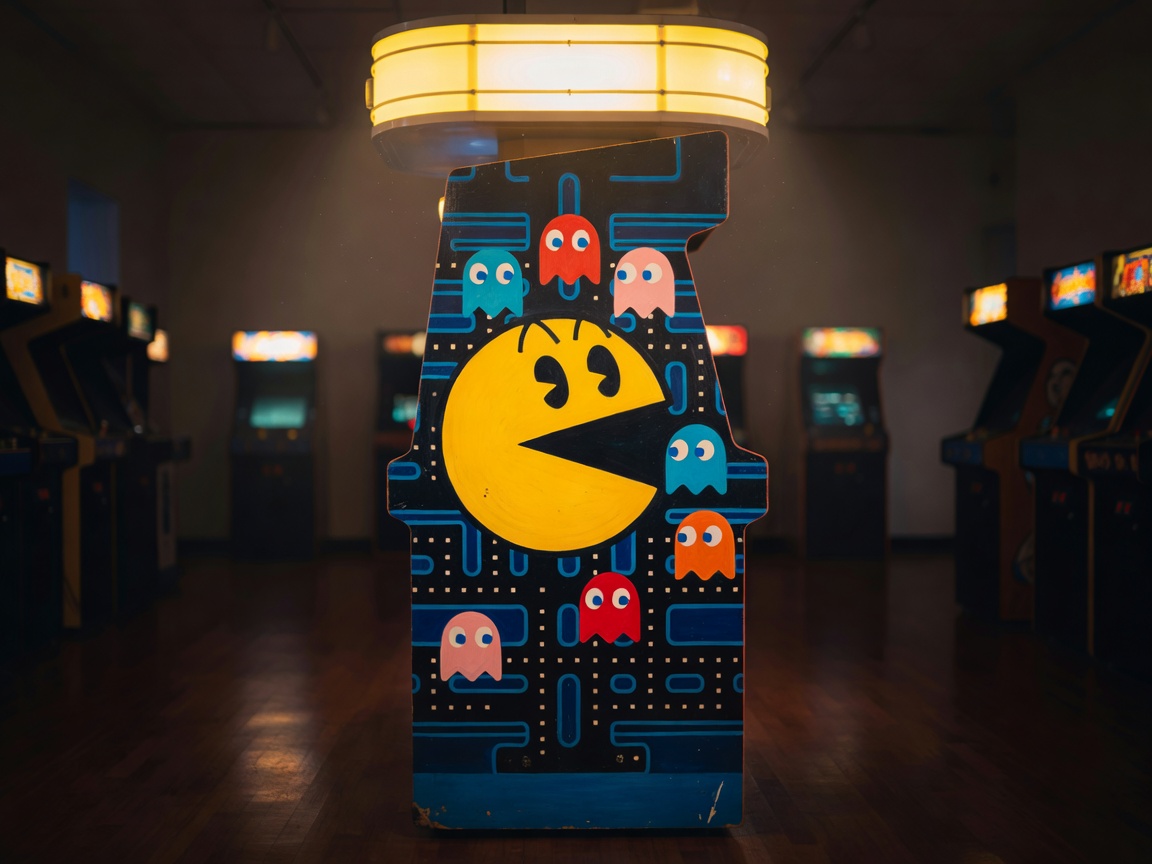
Designed by Toru Iwatani and engineered by Shigeo Funaki for Namco in 1980, the original Pac-Man arcade cabinet set the benchmark for coin-operated video game hardware. Utilizing an 8-bit Zilog Z80 main CPU clocked at 3.072 MHz, the main board architecture relies on discrete TTL logic components for sprite rendering and tilemap overlays rather than a dedicated GPU chip.
Unlike modern raster displays, Pac-Man employs a 19-inch vertical CRT monitor (typically Wells-Gardner 19K4600 or Electrohome G07 chassis) with a custom resolution of 224 × 288 pixels running at a 60.60 Hz refresh rate.
2. HARDWARE SPECIFICATIONS SUMMARY
| Component | Specification Detail |
|---|---|
| Main CPU | Zilog Z80 @ 3.072 MHz |
| Sound Hardware | Namco 3-channel wavetable synthesis (3-bit volume, 20-bit frequency) |
| Video Resolution | 224 × 288 Vertical, 16 Colors from 32 Color Palette |
| RAM Configuration | 1 KB Video RAM, 1 KB Color RAM, 2 KB Work RAM |
| ROM Capacity | 16 KB Main Program EPROMs (2716 chips) |
| Coin Mechanism | Dual 25-cent mechanical coin acceptors with microswitch triggers |
3. DISPLAY CHASSIS & CRT REPAIR GUIDANCE
The standard Electrohome G07 CRT monitor inside original Midway Pac-Man cabinets requires routine capacitor replacements ("cap kits") every decade to prevent horizontal foldover, screen flicker, and frame flyback diode failure. Technicians maintaining original hardware must ensure the +120V DC B+ voltage rail is regulated within ±1.5 volts to avoid long-term screen phosphor burn-in.
⚡ Technical Safety Warning
Cathode Ray Tubes (CRTs) store high voltage up to 20,000 Volts DC inside the second anode button even when unplugged. Always discharge the CRT tube using an insulated grounding tool before servicing the chassis PCB board.
4. CONTROL PANEL WIRING & RESTORATION
The original Pac-Man control panel incorporates a 4-way mechanical restriction plate on the joystick, preventing physical diagonal directional inputs. Attempting to use an 8-way joystick without a 4-way restrictor plate causes Pac-Man to miss turn registers at maze junctions due to simultaneous X/Y microswitch activations.
5. VERIFIED EXTERNAL ARCHIVE LINKS
For original schematics, ROM checksum validation tables, and restoration parts sources, consult official preservation databases:
🔗 Visit International Arcade Museum (KLOV)